Share this Collection
1 Citation in this Annotation:
Annotated by:
Jaehee Shin on Writing In, On, and For Architecture
11 February, 2026
On page 89,
‘CYNTHIA DAVIDSON : I teach a required graduate course, called “Image and Text,” at Pratt, where I try to help the students to understand that an image generally needs explanation in order to be understood in a certain way by the broad population that is involved in the project. So, you could say and implies a supplement. It is important to add words that don’t simply describe what we can already see, which is the students’ tendency to do. They need to write a text that explains the ambition of the project or the goal of the project, that explains what the average viewer would not be able to see or read in the image. We live in an image culture, but that culture also requires texts‘.
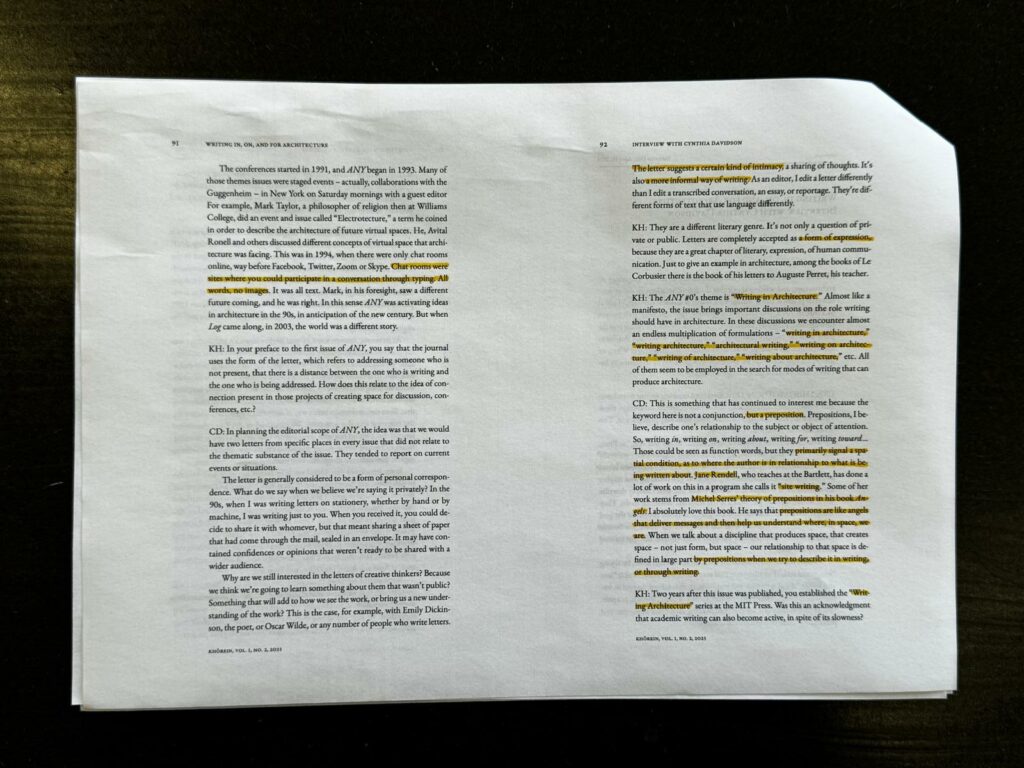
On page 92,
‘KHŌREIN : The ANY #0’s theme is “Writing in Architecture.” Almost like a manifesto, the issue brings important discussions on the role writing should have in architecture. In these discussions we encounter almost an endless multiplication of formulations – “writing in architecture,” “writing architecture,” “architectural writing,” “writing on architecture,” “writing of architecture,” “writing about architecture,” etc. All of them seem to be employed in the search for modes of writing that can produce architecture.
CYNTHIA DAVIDSON : This is something that has continued to interest me because the keyword here is not a conjunction, but a preposition. Prepositions, I believe, describe one’s relationship to the subject or object of attention. So, writing in, writing on, writing about, writing for, writing toward… Those could be seen as function words, but they primarily signal a spatial condition, as to where the author is in relationship to what is being written about. Jane Rendell, who teaches at the Bartlett, has done a lot of work on this in a program she calls it “site writing.” Some of her work stems from Michel Serres’ theory of prepositions in his book Angels. I absolutely love this book. He says that prepositions are like angels that deliver messages and then help us understand where, in space, we are. When we talk about a discipline that produces space, that creates space – not just form, but space – our relationship to that space is defined in large part by prepositions when we try to describe it in writing, or through writing‘.
On page 96,
‘KHŌREIN Manuel Oranzi : I would like to answer this. I think it has something to do with the transition from the printed newspaper to the Internet. This means that newspapers can survive only through opinions and judgment. No more with information. This is all about the crisis of magazines and architecture worldwide. The age of magazines as tools of information is over, they’re gone. It’s another time. We need more critical opinions. I think this is the transition. It’s the same with newspapers. All the newspapers had to face this because of the Internet. Every second you have information. So, of course, what you don’t have are opinions, judgment, critical thinking about the events‘.
On page 97,
CYNTHIA DAVIDSON : Obviously, writing is important as a supplement to the image, or I wouldn’t be teaching it. I don’t think it’s nostalgic at all to advocate for writing, and good writing, because it’s another mode of expression – of thought – that is critically important. There’s no scientific proof, but perhaps writing causes us to dream, even to visualize, in ways that images do not.