Share this Collection
1 Citation in this Annotation:
Annotated by:
Jaehee Shin on frauen formen ihre stadt
12 June, 2026
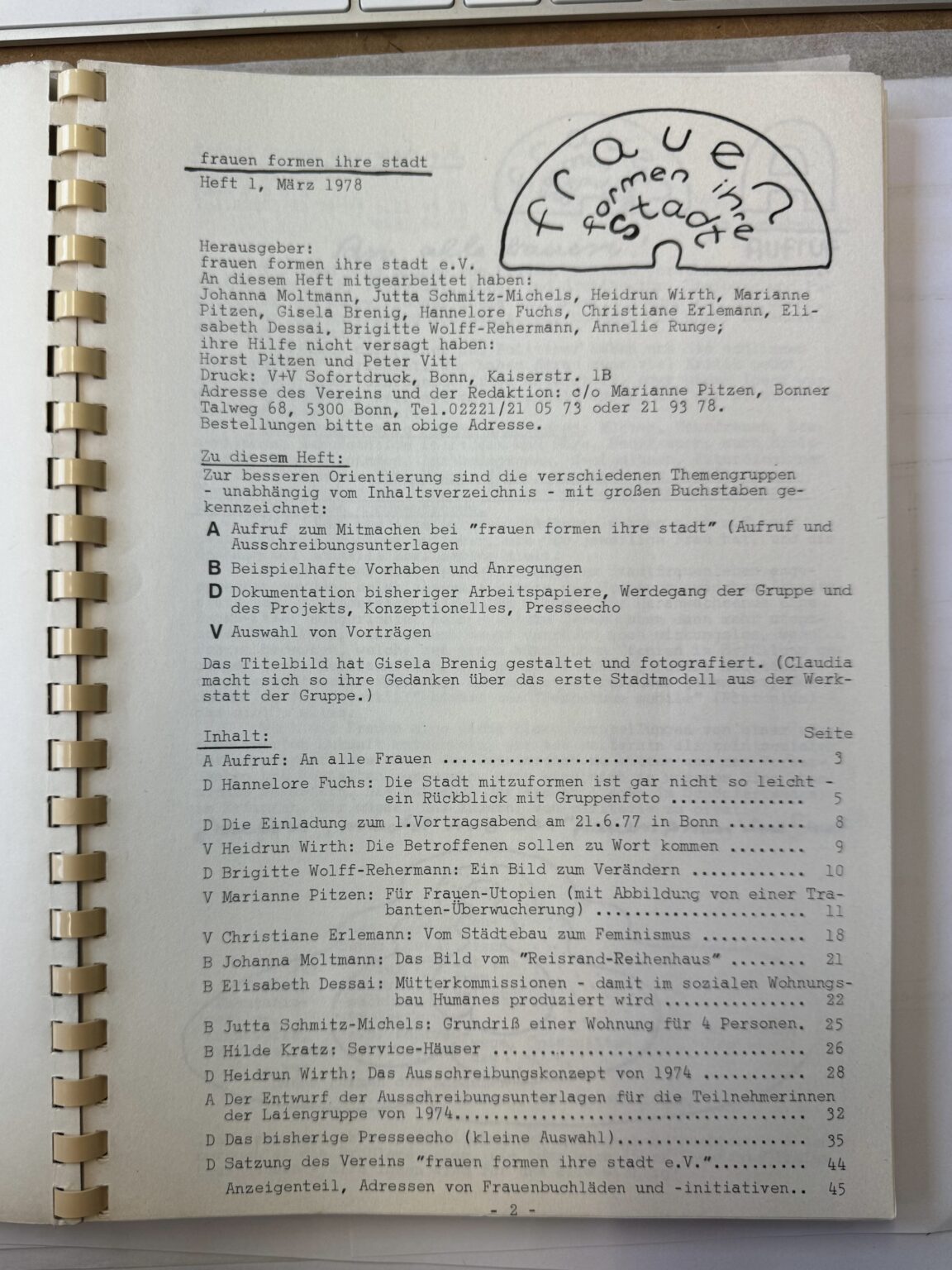
When I visited the Frauenarchiv Graubünden in Chur in May 2023 in search of traces related to Women Writing Architecture, I began exploring books and magazines on architecture among Silke Redolfi’s extensive collection on women’s history and culture. On those densely packed shelves, I encountered issues 1 and 2 of frauen formen ihre stadt—a publication that proved to be a hidden gem, offering a striking insight into the concerns, desires, and political imagination articulated by women in 1977.
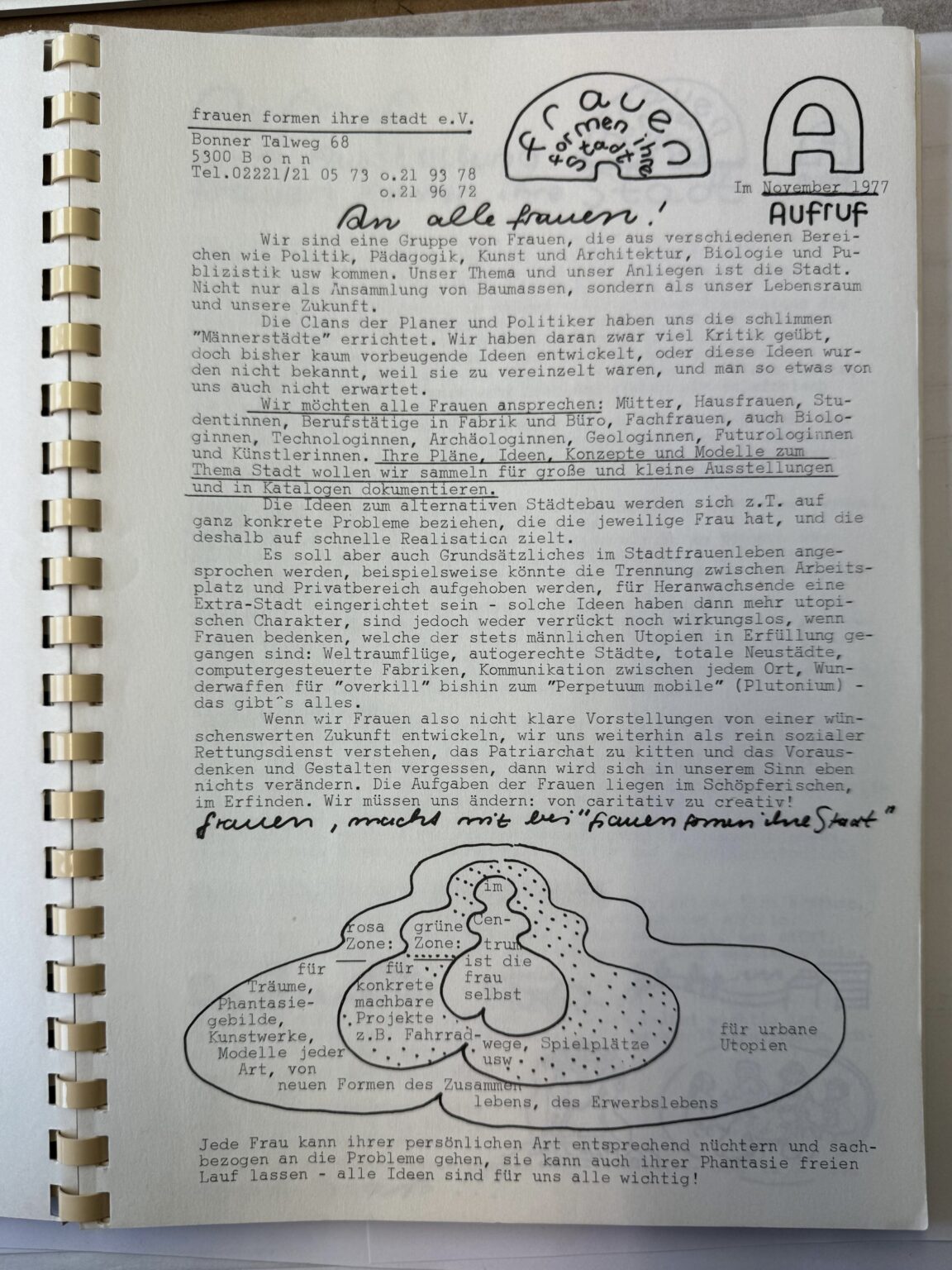
The collective brought together women from diverse fields, including politics, education, art and architecture, biology, and psychology. It emerged from a desire to transform a reality in which, although the devastating consequences of the “male cities” produced by planners and politicians had been widely criticised, alternative visions had either not yet been developed or remained too fragmented to enter public discourse. frauen formen ihre stadt imagined a feminist utopia fundamentally different from the grand narratives of male-dominated utopias. The publication makes clear that unless women themselves articulate concrete visions of a desirable future, they will continue to be confined to the role of social caretakers, thereby reinforcing existing patriarchal structures, and nothing meaningful for women will change. Women, therefore, must take on the task of creation and invention — not merely that of care or charity.
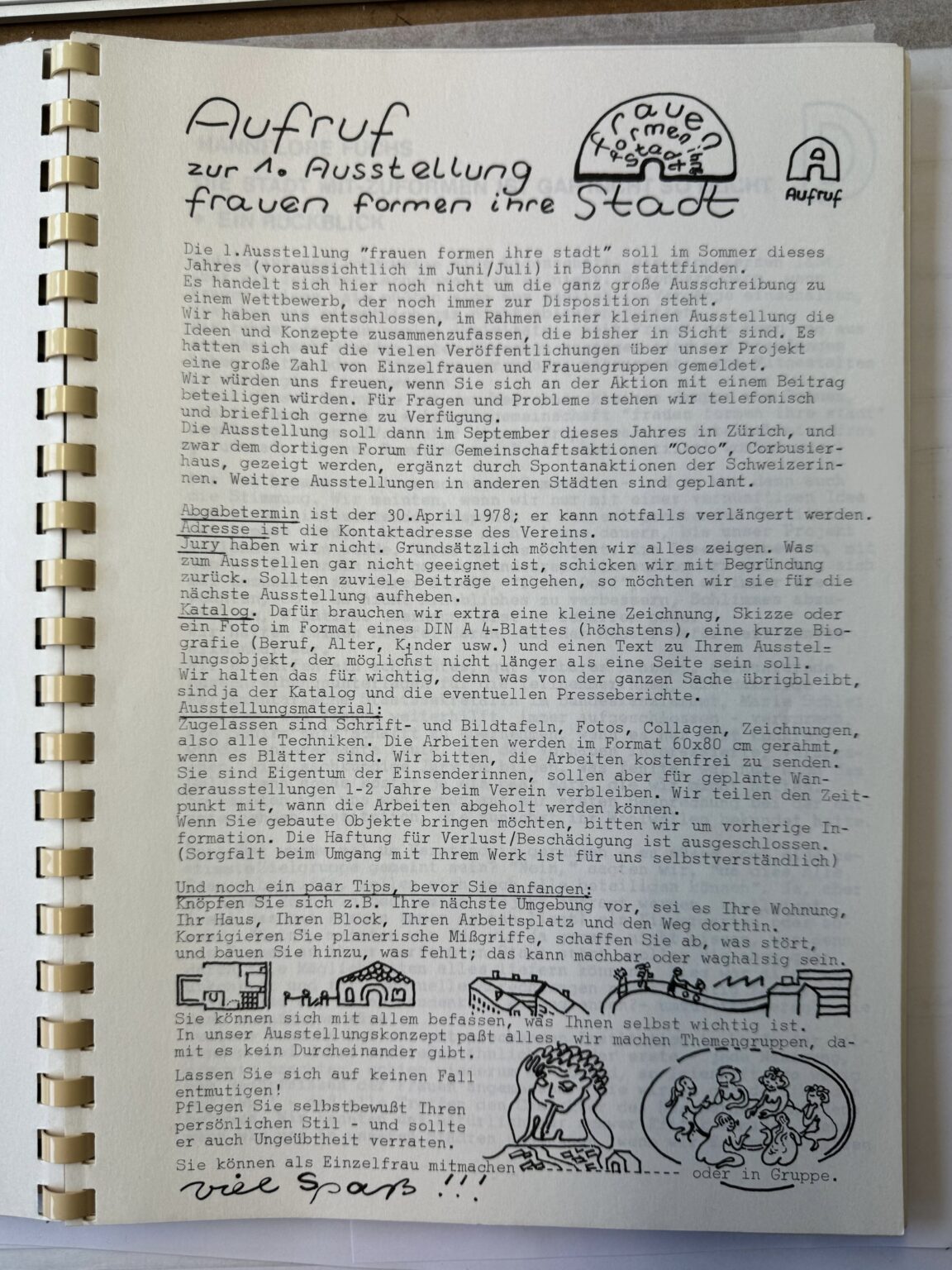
HEIDRUN WIRTH makes it clear that contributing to the making of a city is not an easy task. In the summer of 1974, the working group frauen formen ihre stadt launched an ideas competition inviting women across Germany to observe their own towns and reflect on what needed improvement, what negative aspects should be eliminated, and what important elements should have been created in the first place. Many of the submissions to this open call were met by institutional experts with the judgement that they were unclear, amateurish, or unfeasible. However, the working group argues that the impetus for change would come precisely from ideas generated by a small number of people who had recognised that an attitude toward life is not necessarily tied to formal expertise.
BRIGITTE WOLFF REHERMANN notes that urban planning grounded in a purely male-centred functionalism continues to produce public buildings encircled by glass façades that do not transparently reflect democracy, within which decisions are made by men without meaningful dialogue. Women must participate in order to ensure greater civic engagement. However, she also points out that what complicates this situation for women themselves is that, by accepting recognition as experts within a male-centred system, women risk betraying their own imagination and lived needs. Male-centred knowledge and discourse often lead women to hesitate in articulating what they themselves require. Women’s participation therefore implies that, while they remain fully aware of these structural issues, they do not allow themselves to be completely absorbed into the system. This frequently results in a situation in which generations of women who have succeeded within male-dominated structures turn a deaf ear to the more vocal expressions of younger women, insisting that they conform to already established forms of recognition, thereby making intergenerational solidarity among women more difficult.
Women must become creators who cultivate their own urban imagination and envision alternatives through an ongoing dialogue with themselves. These dreams, acts of imagination, and long-term visions are essential foundations for gaining political influence. Simply calling for a more humane environment is not enough. Women must articulate what needs to change and take action to ensure that women’s experiences, needs, and perspectives are meaningfully reflected.
A women’s utopia does not begin with grand-scale plans. It is fundamentally different from the monumental urban utopias that have been imagined through entirely new cities, underground rail networks, and highways. While we need not deny the existence of vast structures made up of thousands of repetitive elements that continue to be planned today, a women’s utopia begins by empowering individuals — independently of those larger systems. This is because change does not emerge from the top down; it always begins from the bottom up.