Archeoastronomy and Collective Rituals
by
1 February, 2026
There is reason, after all, that some people wish to colonize the moon, and others dance before it as an ancient friend.
James Baldwin
Simone and Gosia of Centrala, guest editors of the March Equinox 2026 women writing architecture Insights newletter, proposed Archeoastronomy and Collective Rituals as their theme:
Regarding the theme for our contribution, we would like to adhere quite literally to the Equinox occurrence, and share our most recent fascination and research into the theme of archeoastronomy and the role that architecture played in facilitating collective rituals of observing the sky. We’d like to reclaim public naked eye observations in opposition to the privileged individualised telescope observations, and we imagined to do so by an array of examples such as the Jantar Mantars of India, the Menhirs of England and the stone circles near the Odra river in Poland.
This collection is women writing architecture’s response to this idea of archeoastronomy. This ongoing collection gathers in sites around the world, and considers ancient collection rituals as generators for architectural structures. In some cases, it takes some time to track down texts written by women, since the literature is dominated by a colonial and / or scientific perspective, both usually male domains.
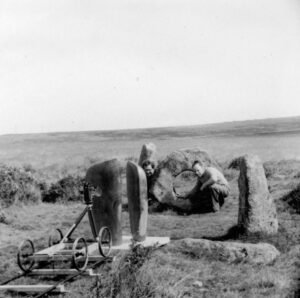
Before women were allowed to be part of the world of science, their knowledge of the science of astronomy was described in magical terms, related to a female engagement with the natural world, as witches and healers whose bodies explicitly revealed the cycles of the heavens. Jacquetta Hawke’s film script for the 1953 documentary on Barbara Hepworth’s responses to the prehistoric and other landmarks of the Cornish landscape in her sculpture include art within this boundary. The essay by Carol Glatz included in the collection also points to the unacknowledged labour of nameless women who mapped the stars for a project called the Star Atlas, or the Carte du Ciel.