Share this Collection
1 Citation in this Annotation:
Annotated by:
Annamaria Prandi on Being Here
18 April, 2026
In 2010, the writer Marie Darrieussecq encountered the work of Paula Modersohn-Becker for the first time. It happened by chance: she received an email promoting a psychoanalytic conference on motherhood, illustrated with a painting of a woman breastfeeding a child. What caught her attention was the unusual pose—mother and child lying naked on a bed, a position many women recognise as comfortable and natural, yet one that was virtually unknown in early twentieth-century art. Who was this artist?
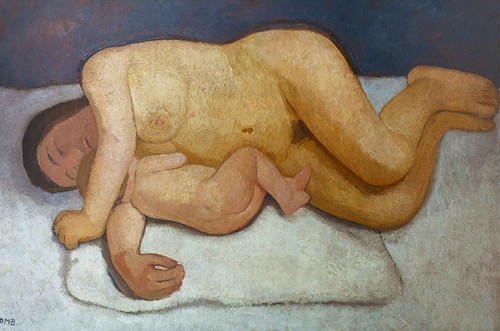
The painter was Paula Modersohn-Becker, born in Dresden in 1876 and dead at just thirty-one, shortly after giving birth to her first child. As she collapsed, she reportedly said: Schade!—what a pity. And indeed, what a pity: the life of a young artist cut short just as her career seemed ready to take off, just as her bold and energetic work might have found recognition within an artistic landscape on the brink of upheaval, soon to be shaken by Cubism and the avant-gardes.
Modersohn-Becker was a figurative painter at a time when, in Europe, only two schools allowed women to attend life drawing and anatomy classes. To study, she had to escape the obligations of family life and travel to Paris. Paris meant life, art, energy—but also solitude, poverty, and uncertainty. And so she moved back and forth between the French capital and Worpswede, the artists’ colony where she lived with her husband, seeking the emotional and financial stability necessary to continue painting. As the Swiss artist Sophie Schaeppi, her contemporary at the Académie Julian, remarked: “The best cure for me would be to have an income of ten thousand francs!” These voices anticipate by twenty years Virginia Woolf’s reflections in A Room of One’s Own.
Darrieussecq intuited the power of this artist. She studied her work and life, and persuaded the Musée d’Art Moderne de Paris to organise a monographic exhibition on Modersohn-Becker, accompanied by her book, Being Here. The writing proceeds in fragments, drawing not only on a close engagement with the paintings but also on the diaries and letters the artist wrote to her mother, her sisters, her husband, and to Rainer Maria Rilke—perhaps her truest interlocutor—as well as to his wife, Clara Westhoff.
What emerges is the poignant struggle of a woman in search of her identity as an artist, perpetually short of time, space, and money. Having moved permanently to Paris, leaving her married life behind, she wrote: “I am no longer Modersohn, and I am no longer Paula Becker either. I am Me, and I hope to become more and more Me.”
A foreigner both in Paris and in her homeland, Paula—as Darrieussecq calls her throughout the book—never loses her certainty of being an artist. A cruelly ironic death brought her path to an abrupt end. The book—Being Here Is Splendor, a title drawn from Duino Elegies—celebrates her and seeks to restore her to a central place not only in the history of art, but also in the history of female and feminist thought.